Daniel Tafoya – Generalist Programmer
Introduction
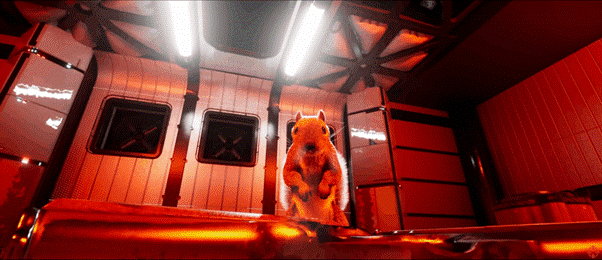
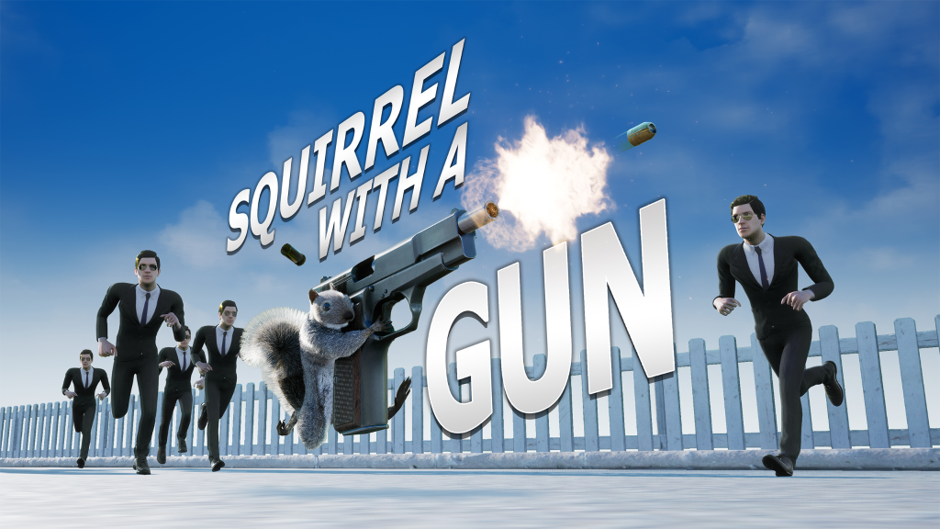
When the idea of a squirrel infiltrating a military testing zone with the sole mission of gathering as many nuts as possible came to us, and we learned that this concept would be ported to consoles alongside another team, everything clicked into place. It was not the first port born from the collaboration between both studios, which foreshadowed a brilliant piece of work, as on previous occasions. While one studio took charge of the console adjustments, nothing would have gone as smoothly without the communication and synchronization between both teams.
The Challenge
One of the main challenges we faced was being able to properly communicate to the developers the changes and adjustments required for assets, images, videos, and more to work correctly on both consoles and PC, as well as the necessary tweaks to game dynamics and correctly simulating the squirrel’s fur. It was not just about pointing out that an asset or the fur was not working, but rather proposing solutions and determining which of them suited both parties.
● Correct Asset Configuration: When the base game is built directly for PC without considering that a port is in progress, compatibility issues on consoles often arise: images that fail to render, videos with incorrect encoding, or textures that fall short of the required quality.
● Game Dynamics: Throughout development, we identified certain dynamics that might not cause issues on PC; however, on consoles, those same dynamics could lead to significant FPS drops due to high consumption of physics calculations or excessive use of particles and special effects.
● Fur Simulation: In the base PC project, the rendering of the squirrel’s fur worked correctly with the original shaders; however, on consoles, the opposite occurred.
Key Criteria
The objective was always to maintain the essence of the base game and preserve the details of the environment and the squirrel as faithfully as possible, respecting the original concept. Following this idea:
● Maintaining Game Quality: The challenge was to preserve the quality of the scenery, particles, and squirrel fur, and to take full advantage of the console hardware potential. To achieve this, we utilized various configurations and post-processing improvements that allowed us to maximize the environment without needing to modify anything.
The Solution
It is worth mentioning that while our team took on the task of seeking and proposing performance and quality improvements for the consoles, the other team was always open to listening to new ideas and ready to contribute their perspective to take those improvements even further.
Performance Improvements
We significantly improved asset loading to provide a stable framerate, which was reflected in fluid gameplay.
● Scenario Streaming: We avoided overloading assets or resources that were not necessary at that moment by loading scenarios in fragments and making anticipatory loads of new zones so that the user would not notice those transitions. This streaming strategy was jointly validated with the original team to ensure that the exploration experience remained intact.
● Shader Improvements: The shaders were modified using more optimal processes for consoles, which facilitated rendering without losing visual quality or altering the final result. Each iteration was reviewed in synchronized sessions with the client’s art team to ensure that the game’s look remained faithful to the original concept
● Physics Simulation Improvements: We optimized the parameters of the Unreal Engine physics engine to speed up those simulations. We adjusted internal values so they would be more efficient to represent without the need for heavy calculations. These changes were communicated in advance to the design team to avoid impacting gameplay.
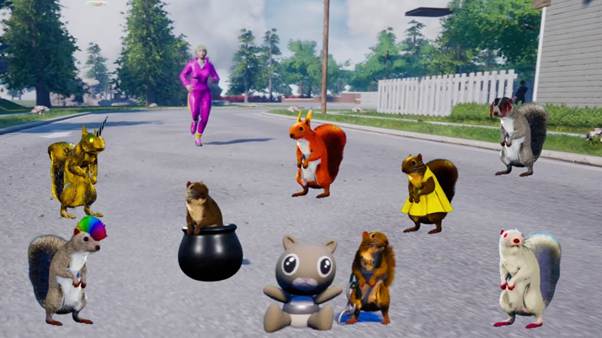
● Fur Simulation: We had to experiment extensively with the squirrel’s fur shader, given that it features many different skins, all of which were modified not only in color but also in fur density in different areas. However, thanks to the technical skill of the art team in charge of creating the shader and various console-specific configurations, we managed to maintain the essence of each skin. This was an iterative process where constant feedback between both studios was decisive in locking the final look.
Results
● Performance Improvement: We achieved a stable framerate on consoles.
● Game Quality: We maximized visual quality without losing details or modifying the environment.
● Fur: The squirrel ended up looking great in all of its skins, and each one maintained its details without modifications.
● Successful Launch: The game shipped on time and without delays, as did the subsequent updates.
While the GameCoder Studios team’s work was up to the level of such a technical project, we must never forget that none of this would have been possible without constant communication and feedback from both teams. Both teams were responsible for bringing this project to a successful conclusion, and it was that mutual cooperation that turned this port into one of the most rewarding and enriching endeavors in our trajectory.